1of 10 list
Art Seen is pleased to announce The Objects are Watching a new solo exhibition by London artist, Clare Burnett curated by Maria Stathi with a commisioned text by Pavlina Paraskevaidou.
Towards an archaeology of the future
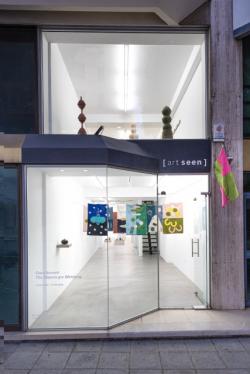
“The flags are hanging upside down”, (2026).
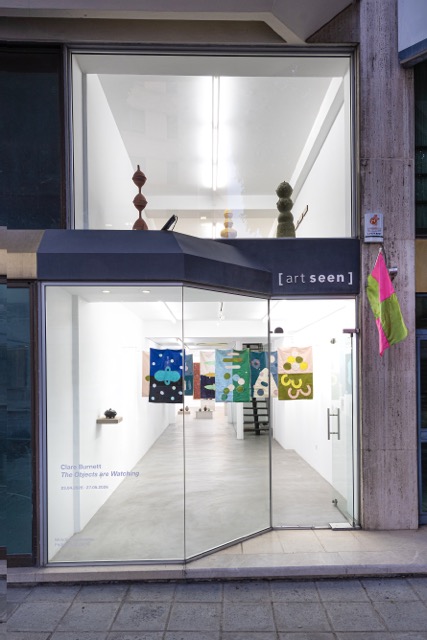
A flag in green and pink with a dividing line and overlapping geometric shapes across its surface, flies above the entrance to Clare Burnett’s new exhibition “The Objects are Watching” at Art Seen, Nicosia. (1)
Clare Burnett’s work is a response to people, places and histories, unravelling narratives and associations across different times and landscapes. Past and present are intertwined through colour, form and material into objects that reflect the movement of people. Her research for the current exhibition led her on a journey, from studying the Cyprus Collections at Neues Museum in Berlin and the Pushkin Museum in Moscow, to travelling around the island, learning from people and observing the surroundings. The artist scours Nicosia’s supermarkets, trails to remote places in the mountains to find the copper mine and Red Lake of Mitsero and digs the earth of the buffer zone, unearthing stories and collecting materials which she incorporates in her work. Minerals, oxides, clay and earth, which the artist uses to make her own pigments, fabric, paper pulp, and plastic, weave their way into her drawings, sculptures and ceramics.
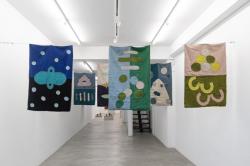
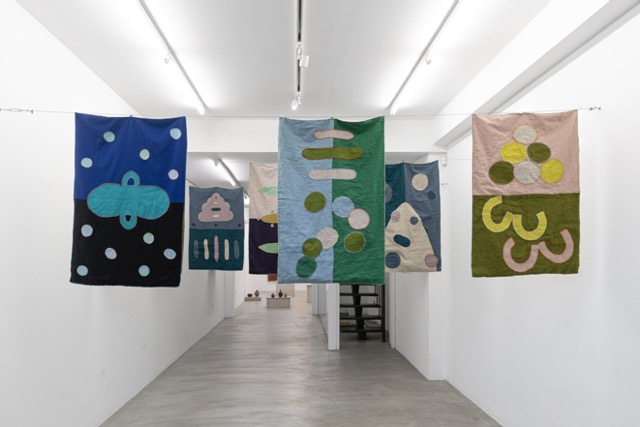
Inside the exhibition a sea of flags in shades of blue, green, pink and yellow from the series “Lines in the Sand” (2026) greet the visitor. This is the first time the artist uses fabric as she seeks to explore new materials and techniques that can best convey an idea. Each flag is divided in two, a reminder of the physical and mental divisions and borders that surround us. Clare’s flags however, with their subtle hues and abstract shapes derived from ancient pottery, are welcoming, rather than alienating. They aim to be reconciliatory and inclusive, in celebration of coming together and an antidote to the proliferation of the symbols of conflicting nationalisms in our communities that are inscribed in the collective conscience.
Clare remains fascinated by the stories behind archaeological artefacts, exposing the patterns of acquisitions and their diaspora around the world, set against contemporary attitudes to the trade of contemporary goods and antiquities and the ethics of restitution. Following on from her earlier investigations into the legacy of Louis Palma di Cesnola, the infamous amateur archaeologist who transported a huge number of Cypriot antiquities abroad, Clare’s research leads her to another amateur archaeologist and antiquarian, Max Ohnefalsch-Richter and his wife Magda, who accompanied him as an assistant and official photographer during his excavation assignments. He arrived in Cyprus from Germany during British rule to work as a journalist, but was subsequently employed by the colonial government to carry out excavations at Idalion, Politico and Tamassos. Excavating at a time when rules were easily bent, Ohnefalsch-Richter was caught smuggling antiquities in 1910 and banned from any further excavations. Yet, these early expeditions produced a huge number of archaeological artefacts (2). Clare pieces together the journey of those antiquities excavated in Cyprus and exported by Ohnefalsch-Richter to many parts of the world, including Germany, before some of them finding their way after WWII to the former Soviet Union and the Pushkin Museum in Moscow in the bags of Russian soldiers. “Lost and Found” (2026) is a cyanotype drawing of everything in the collection at Neues Museum in the style of Max Ohnefalsch-Richter who would meticulously record his findings.
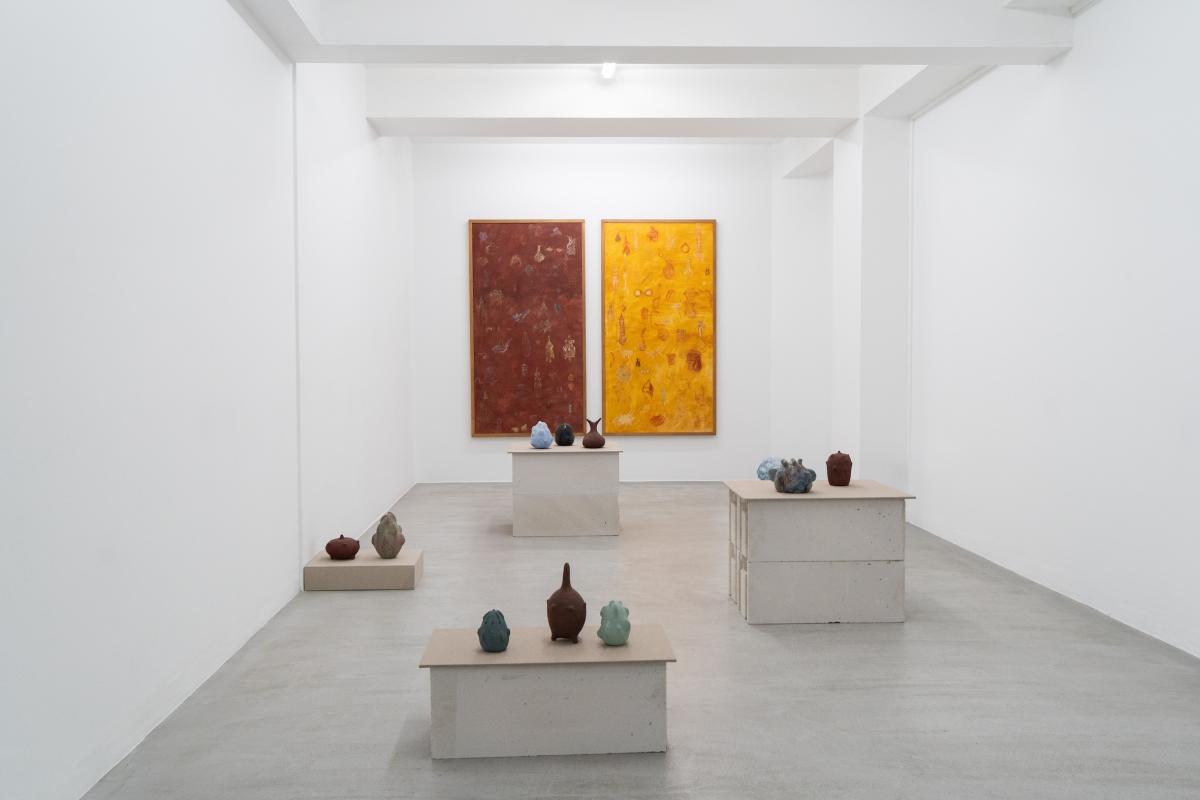
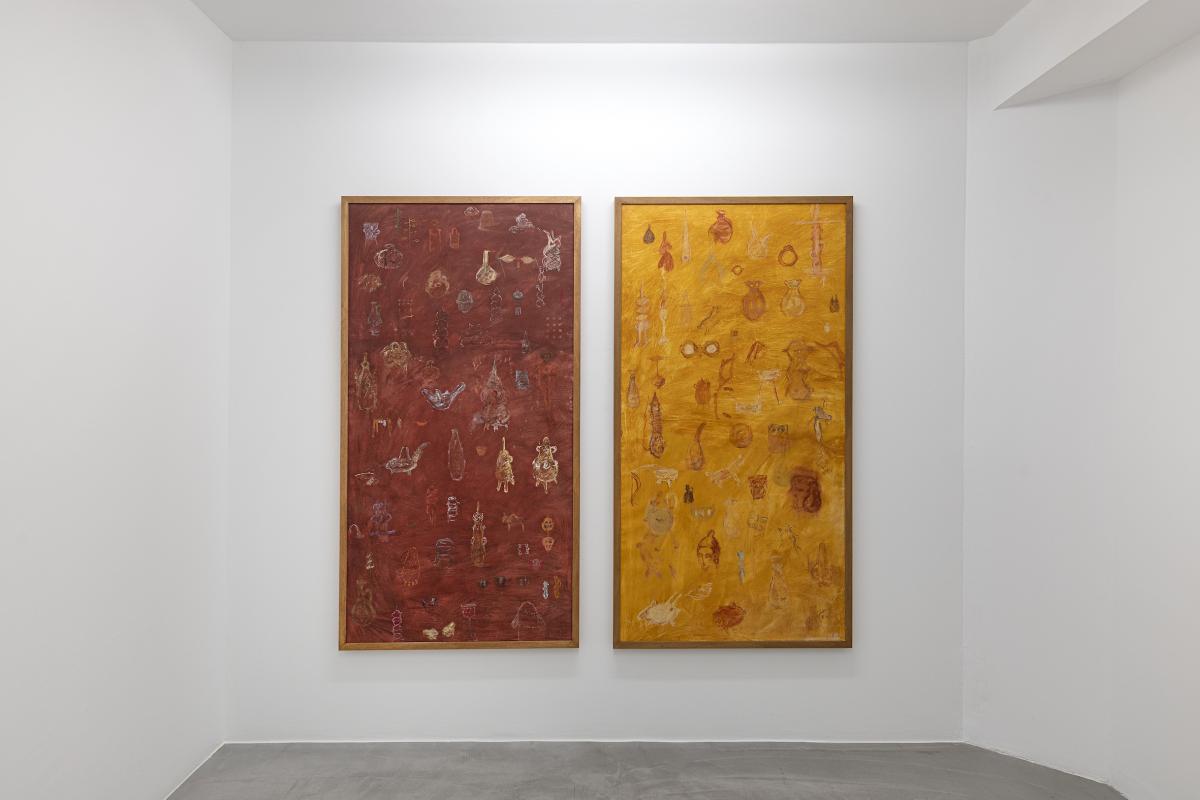
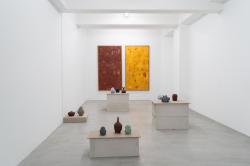
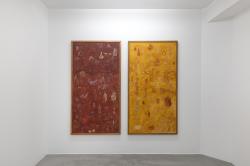
Similarly, the larger drawings “Palimpsest (Red)” and “Palimpsest (Ochre)” (2026), drawn with pastels made from the ochres and earth sourced locally, are a collection of domestic objects, ranging from archaeological artefacts from Berlin and Moscow, to objects included in Magda Ohnefalsch-Richter’s book “Griechische site und gebrauche aug Cypern”, (1913) (3) alongside contemporary works by the artist. A careful examination of the various objects reveals a striking resemblance between old and new, albeit the former in clay and the latter in plastic. This medley of objects constitutes the artist’s visual vocabulary and appears in different forms throughout the exhibition.
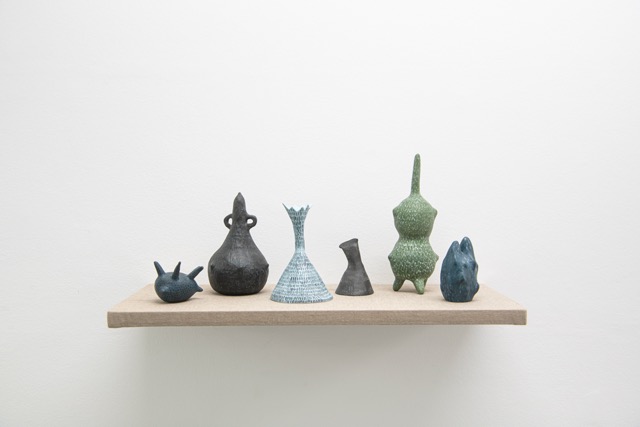
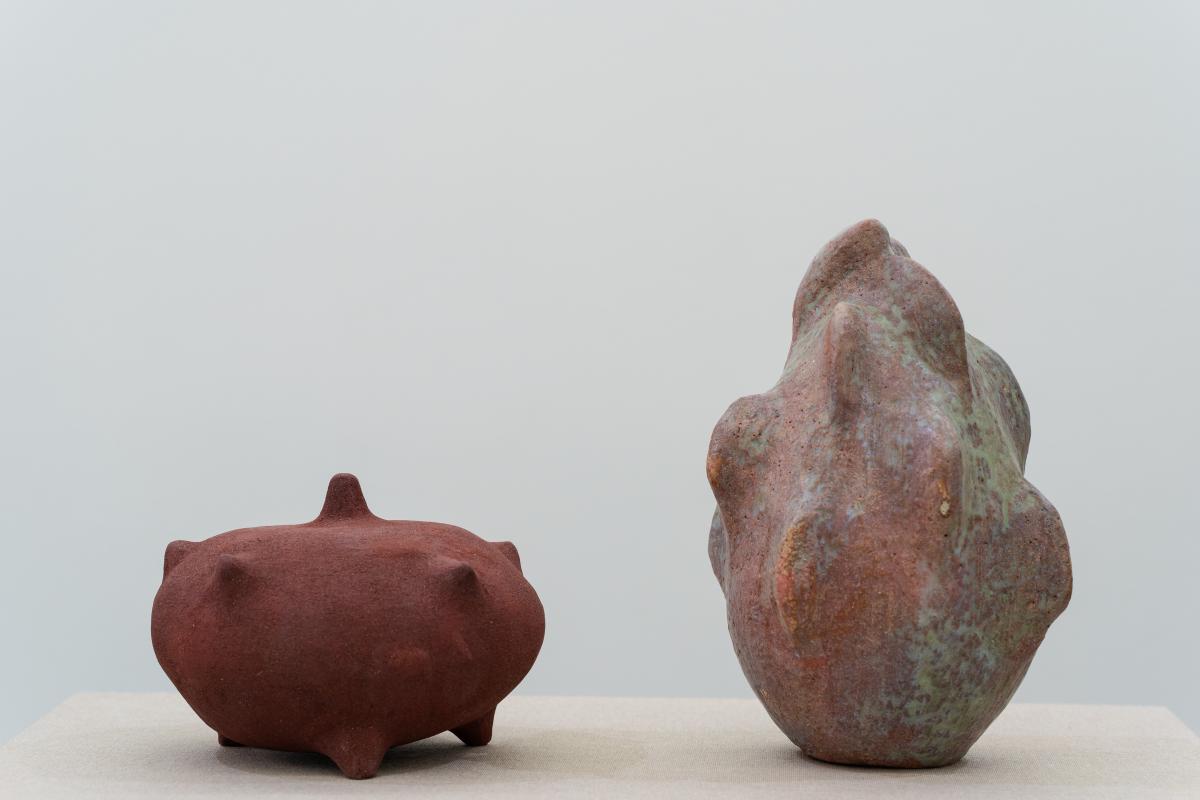
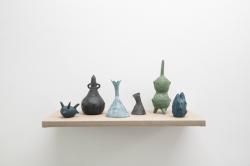
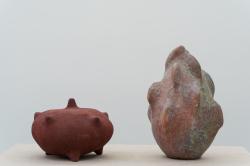
Some of the objects in the aforementioned drawings appear in “The Visitors”, (2026), a series of small works in clay arranged in clusters of two or three. Reminiscent of formal museum displays or Giorgio Morandi’s compositions, Clare traces the journey of these objects from ancient times to present day, revealing that little has changed. A vessel with a spout, bulbous and organic forms with protrusions, deep terracotta colour or glazes which the artist makes herself, these are the travellers of the past to the present.
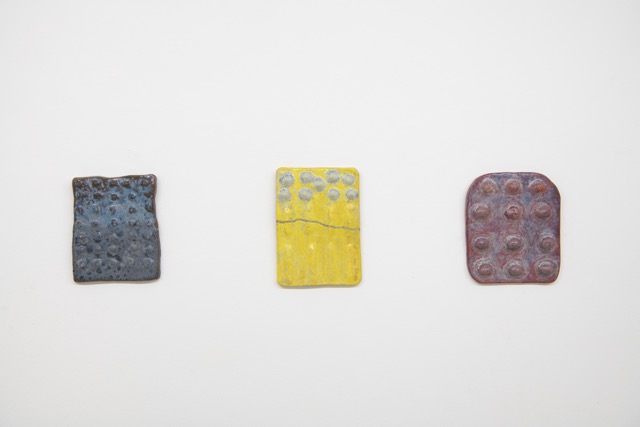
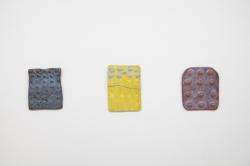
The notion of journey, as well as the conditions of travel of both objects and people is also reflected in the series “Mementoes” (2026). The three tablets in yellow, blue and terracotta with spherical protrusions on their surface are inspired from a tablet part of the Cypriot Collection in the Pushkin Museum. Interestingly enough, the artist discovered that all things that came from Germany are titled “Provenance Unknown. Till 1945 in Berlin Museums, Germany”
Three small watercolour drawings “Berlin notebook” feature objects again from Neues Museum with details of who found them, including Cesnola, Ohnefalsch-Richter and others. Like an old-style inventory rendered in a contemporary manner, these watercolours are set in epoxy on wood, elevating everyday objects to an object of admiration encased in plastic.
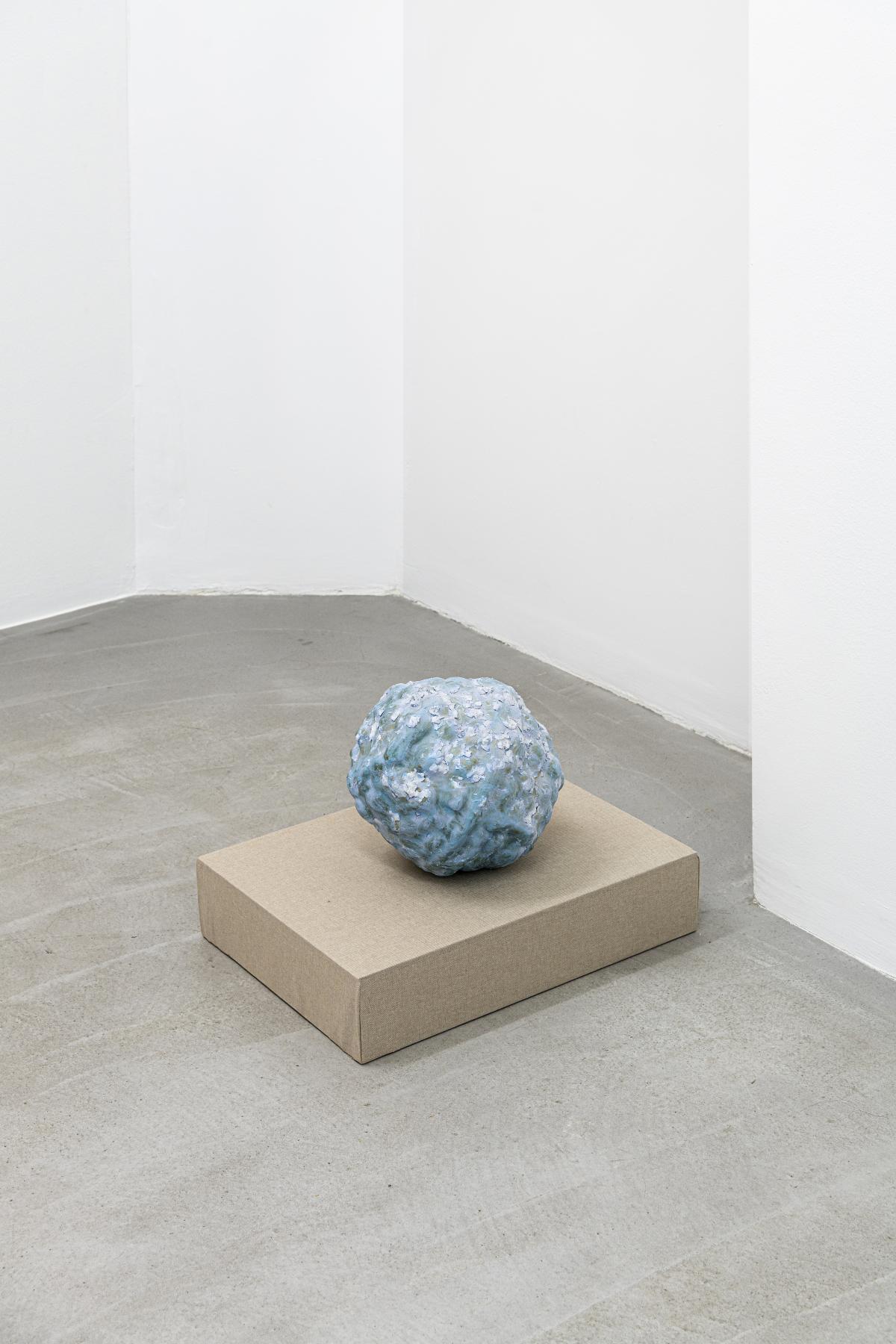
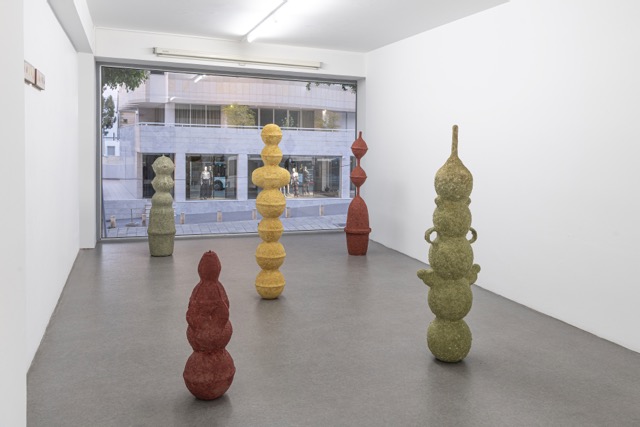
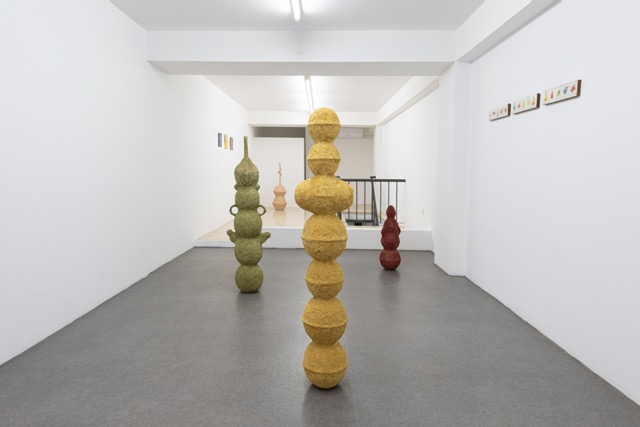
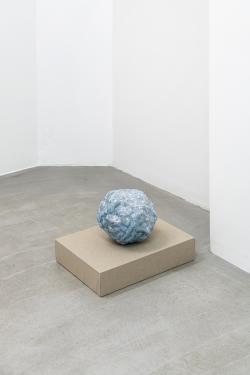
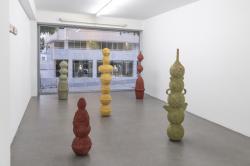
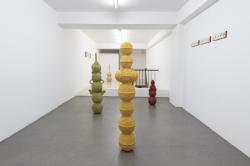
All materials carry the same value for the artist, who dismisses “art world” hierarchies of value. This is exemplified in her use of plastic, paper and clay as an equal of other “precious” materials. The homonymous series “The Objects are Watching”, (2026) are stacked bowls, buckets and other readily available plastic objects under layers of papier-mâché. Reconfigured into anthropomorphic sculptures, they stand tall, like totems of contemporary consumerism or harbingers of an ecological disaster. “Like the household terracottas of the past, today’s everyday plastics bear witness,” the artist writes “watching over our actions and lives until they too become the archaeology of the future.”
Pavlina Paraskevaidou, Art Historian
Footnotes:
(1) The title “The Flags are Hanging Upside Down” is from the poem To the Flags that Have Frayed, Doros Loizou (1944-1974) who was a Cypriot poet and leader of the youth section of EDEK. He was killed during a failed plot to assassinate Vassos Lyssarides, leader of the political party EDEK. Reference with thanks from Maro Emmanuel.
(2) 140 years later several sites originally excavated by Max Ohnefalsh-Richter have been revisited and re-excavated.
(3) Magda Ohnefalsch-Richter’s book (transl: Greek Manners and Customs in Cyprus) offers an insight into everyday life in Cyprus during British Colonial rule.
About the artist
Clare Burnett
Clare lives and works in London, UK. She studied Architecture, Law and Social and Political Sciences at Christs College, Cambridge, Fine Art at the Byam Shaw School of Art (St Martin's) and Art Educationat the Institute of Education, London.
From 2015- 2022 she was President of the Royal Society of Sculptors. She grew up in France and Belgium and has studios in Berlin and London, shows nationally internationally and is represented by Art Seen in Cyprus.
Solo and group shows include: DECENNIAL: A Creative Legacy | 10 year anniversary, Art Seen Gallery, Nicosia, Cyprus (2025); HS Projects, Howick Place, London SW1 (2025); Secret Gazes Clare Burnett and Chris Akordalitis, Art Seen Gallery, Limassol, Cyprus (2024); Sculpture in the City 13th Edition (2024-25); Shapeshifters – Clouds of Conscience. Art Seen, Nicosia, Cyprus (2023); Interwoven, Clare Burnett and Claude Vergez, Hansard Studio, London (2023); Secret Sentinels, Royal Society of Sculptors Terrace (2023); One to Ten Gallery, Online exhibition (2022); Museum Series Part 1: Bloomsbury Design, London (2022); Play Clare Burnett. Offshoot Arts (2020); Impromptu(s) Clare Burnett and Juliette Dominati, Unit One Gallery, London (2020); A Month in Mexico, Studio Block M74, Mexico City (2019); Alive in the Universe at 58th Venice Biennale (2019); In Hope The Lookout, Aldeburgh (2018); Improvisations, School of Design, University of Leeds (2016); Pink, William Benington Gallery, London (2015); Folded, Leighton House, Perrin Gallery and House (with RBKC residency) (2012).
Site-specific installations include: Le Corbusier’s Unite d’Habitation, France; Brompton and Norwood Cemeteries and Bishopsgate Square. London. In 2025 she was commisioned by Hive Curates in collaboration with Landsec to create a public artwork for Timber Square, Bankside, London. Her work is in public collections in Germany, Cyprus, the USA, the UK and China.
Collections include: Museum Kunst und Gewerbe (MK&G) Hamburg; State Collection of Cyprus; Metropolitan Museum of Art, New York; Maggie’s Cancer Care. Private collections in Cyprus, Mexico, Germany, France, UK and USA.
Awards: Arts Council Project Grant; Royal Borough of Kensington and Chelsea Travel Grant; British Council Exhibition Grant.
Parallel Events
*Saturday 25.04.26
Meet the artist Clare Burnett & exhibition tour at 11:30
The gallery will be open 11:00 to 13:00
For more information, please contact: Maria Stathi, Founder & Director, Art Seen
+357 22006624 | info@art-seen.org | www.art-seen.org
For more information, please contact: Maria Stathi, Founder & Director, Art Seen+357 22006624 | info@art-seen.org | www.art-seen.org