1of 6 list
Art Seen is pleased to present Andreas Kalli’s solo exhibition, The Future of the Past, opening on 25 September 2026 at Art Seen by Maria Stathi in Nicosia, Cyprus.
In this new body of work, Andreas Kalli brings together sculpture, kinetic installations, paintings and prints, exploring the enduring relationship between the individual and their social and existential environment.
Through movement, material and form, Kalli constructs self-contained narratives of inner dialogue, in which personal experience is transformed into a shared condition.
The exhibition is curated by Maria Stathi and accompanied by a text by art historian Niki Papaspyrou, who writes:
“The warmest hope awakens in the state of deepest despair”
Byung-Chul Han, The Spirit of Hope, trans. Vassilis Tsalis, Athens: Opera, 2026
The past never remains where we left it. It returns transformed, as active matter permeating the present: in the repetition of a gesture, in the familiar suddenly revealing another aspect, in the defences that have become attached to our very identity, but also in all that has yet to be realised. The title The Future of the Past crystallises a temporal paradox: whatever has remained unresolved continues to act upon the present and, for precisely that reason, remains open to a different outcome. The sense of confinement takes root in our inability to distance ourselves from that which protects us and, at the same time, wounds us. Yet within this same ambivalence, the possibility of movement begins to emerge. Freedom, then, is not synonymous with forgetting or with a violent severance from what came before. It begins when repetition ceases to be experienced as destiny and becomes a field of working-through, allowing desire to turn towards a different mode of existence.
Kalli’s practice is concerned above all with what remains suspended: intention before it assumes a definitive form, desire before it is exhausted in its fulfilment. In his sculpture and painting, personal memory exceeds the bounds of autobiography and is transmuted into a field of collective recognition. Resilience encounters vulnerability, weight encounters suspension, and protection encounters threat, within fragile balances that do not resolve these oppositions but keep them active. Tension thus becomes the structural principle of a body of work in which absence acquires materiality, transition finds a rhythm, and anticipation assumes visible form.
This new body of work by Andreas Kalli occupies the delicate zone between attachment and movement. The exhibition does not set the sense of confinement and the experience of freedom against one another as fixed poles; instead, it articulates them as shifting tensions within a shared psychological, material and spatial continuum. The exhibition space of Art Seen is activated as a dramaturgical field. The passage from the ground floor to the upper level takes on the character of an inner displacement. The slow movement of the sculptures inscribes duration, waiting and gradual transformation into the act of viewing, shifting perception from the eye to the body, which is called upon to attune itself to the temporality of the work.
The exhibition opens with The Famous Black Ribbon: a balloon hangs in space and rotates around its axis. Its circular motion evokes a vortex, a force that carries away and simultaneously holds back. A fragile symbol of ascent and lightness, the balloon is accompanied by a black ribbon that transforms the desire for escape into a state of suspension. The tension between gravity and levitation does not cancel movement; it holds it in suspense, heightening the anticipation of ascent.
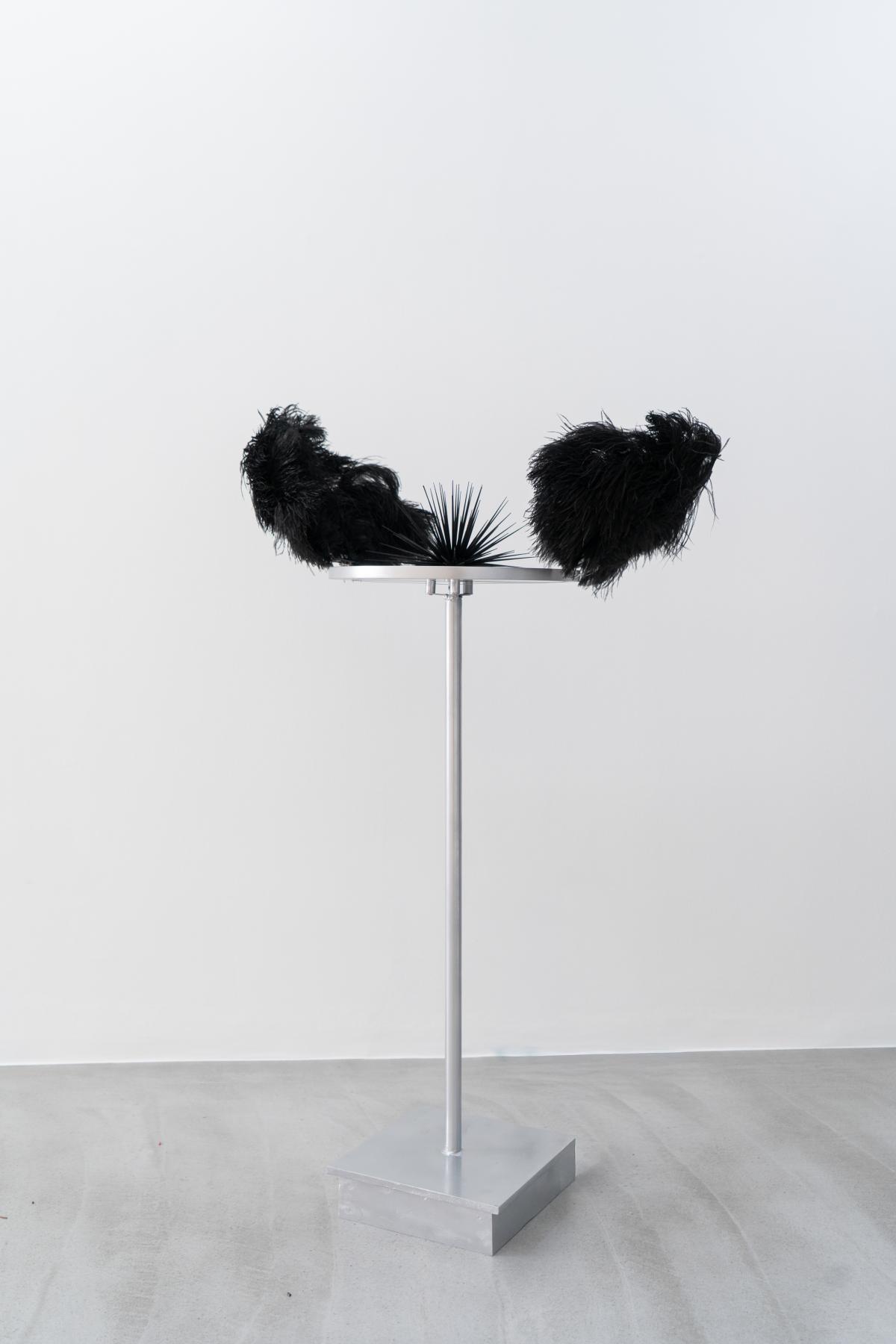
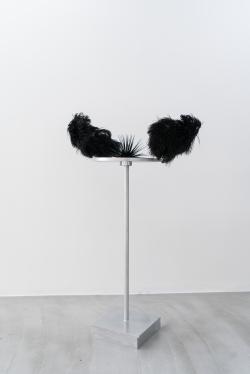
In The Secret of Confession, two large black feathers open and close around a sea urchin cast in black resin, set upon a spare, silver-toned base. The encounter between the softness of the feathers and the spiked shell produces an ambiguous conjunction of protection and threat, wound and defence, exposure and concealment. The sea urchin bears its defence inscribed upon its surface: its shell makes visible a vulnerability that has learned to protect itself. The feathers oscillate between care and restraint, at times closing around it as a shelter and at others tracing the boundary of confinement. Their repetitive movement gives concealment and revelation the rhythm of an inner life seeking to open itself, poised between the need for protection and the desire to be revealed.
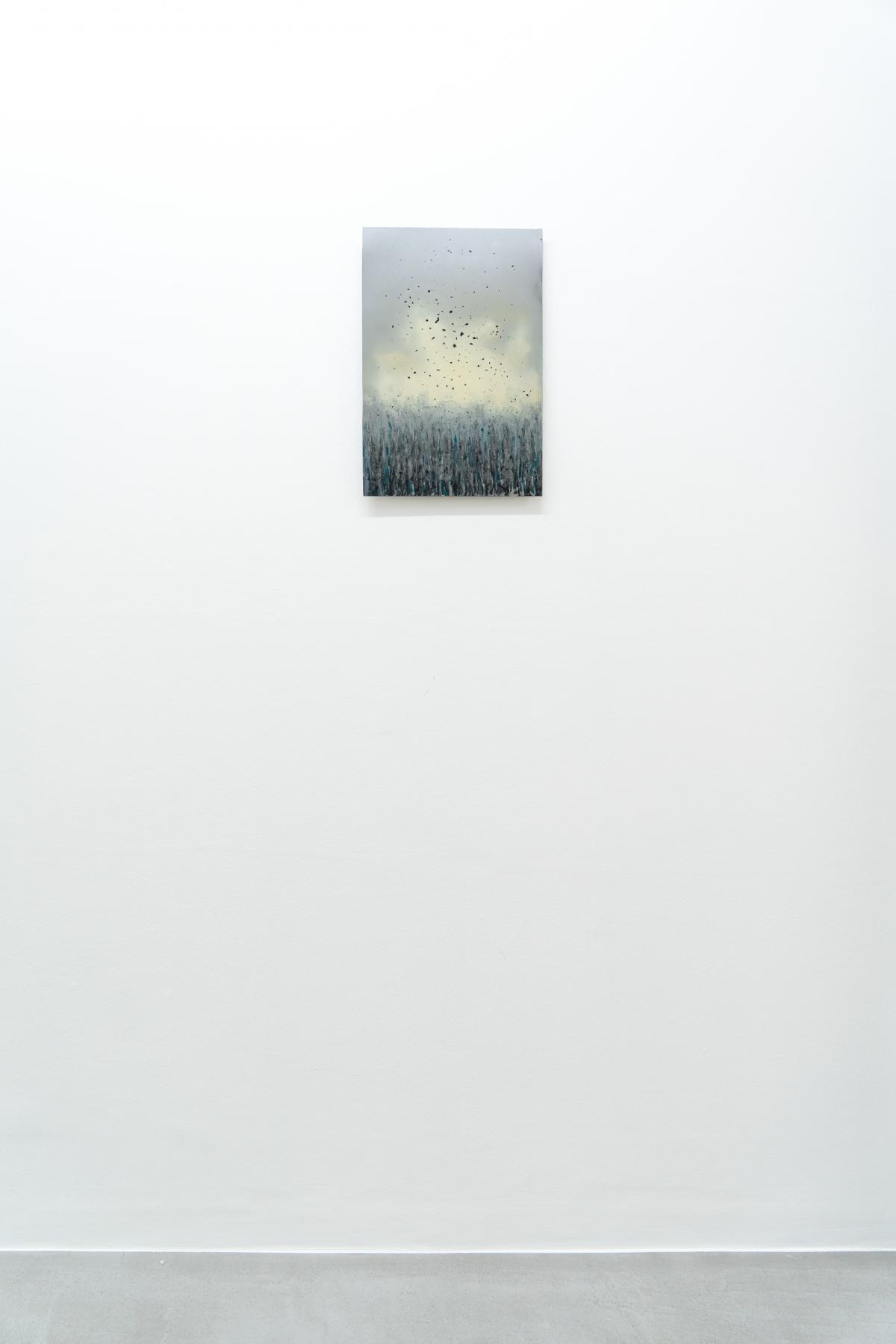
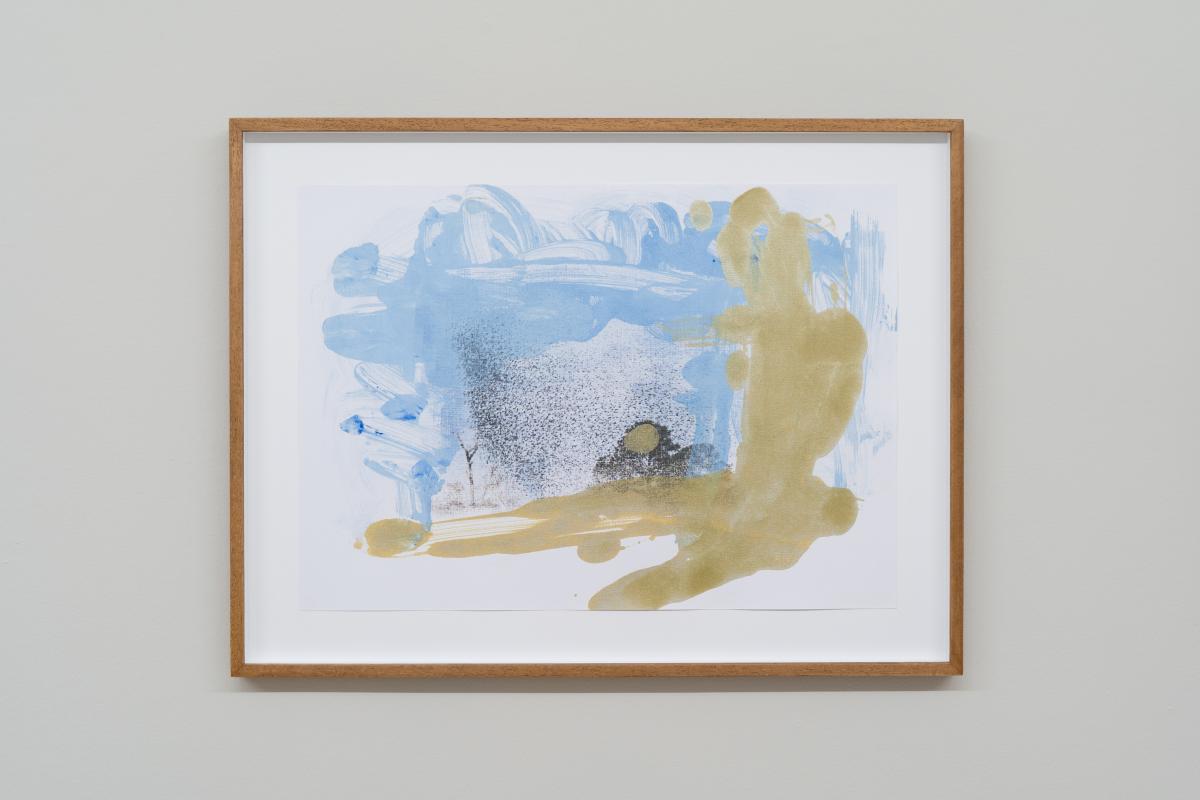
Metal, a silvery sheen and black compose the exhibition’s restrained visual grammar. In the painting on metal, the sea, palm trees and sunset introduce a different tonality. The image of a familiar route does not function as a nostalgic return, but as a passage through memory, through which the present reconsiders its relationship to what came before and imagines alternative horizons.
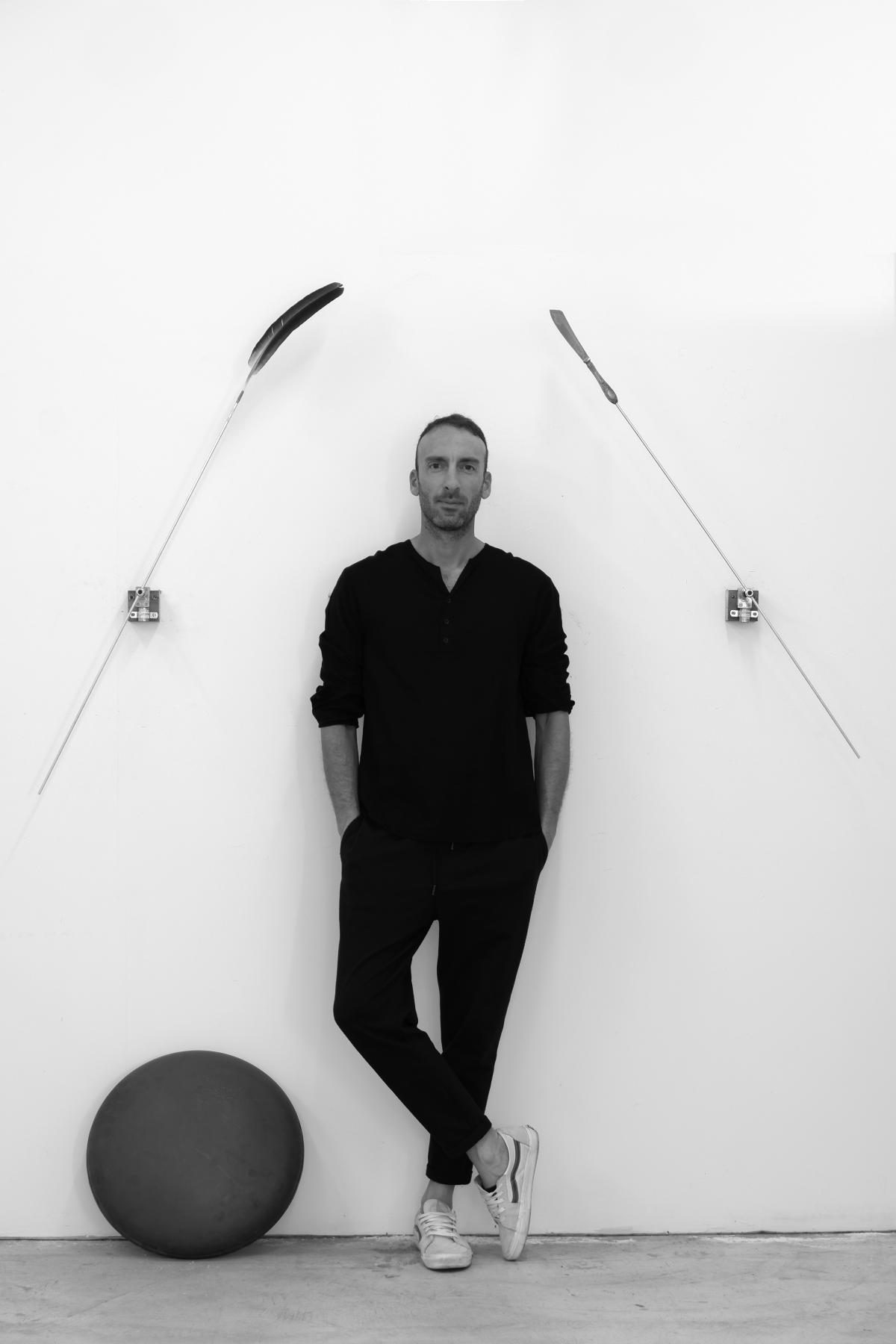
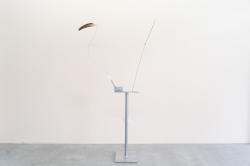
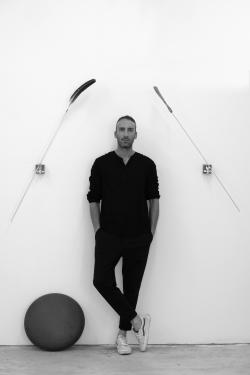
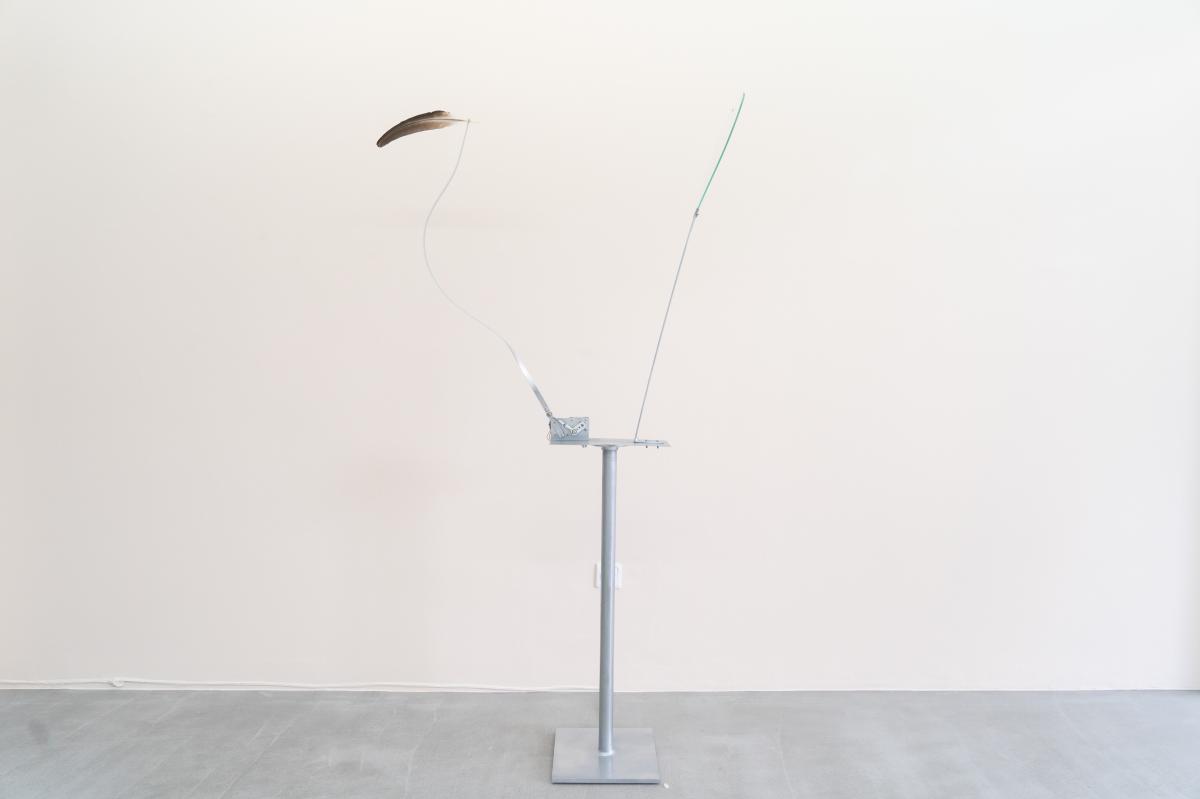
At the far end of the space, in the kinetic sculpture Los enamorados, a feather and a knife approach one another without ever touching, before a polished metal sphere. Their suspended proximity holds tenderness and wounding, attraction and fear, in tension. The reflective surface returns the viewer’s image and incorporates them into the work as an ephemeral presence. The encounter with the self thus shifts towards a relationship with the other, as the image of the self is formed within a field of looking, projection and desire. The distance that never closes becomes both the site of desire and the condition of an intimacy that does not erase difference.
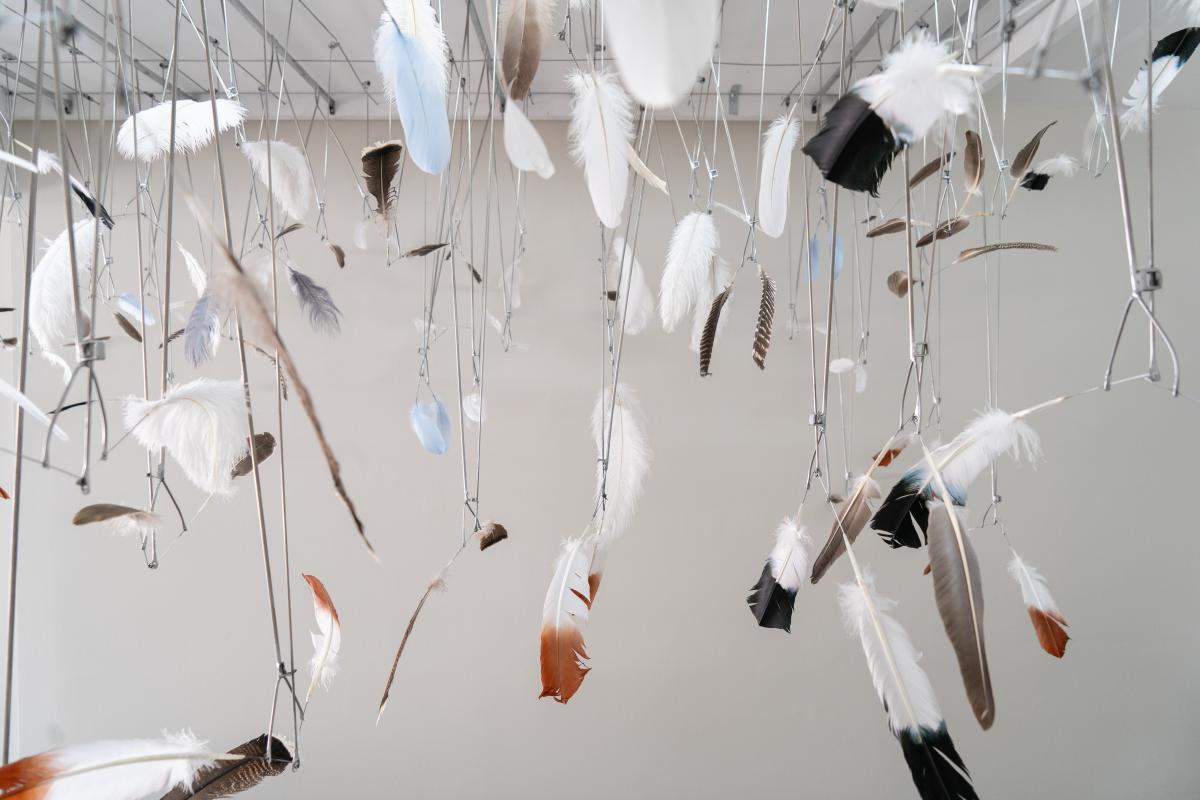
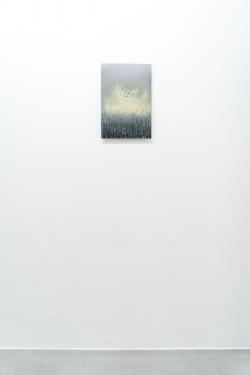
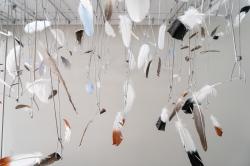
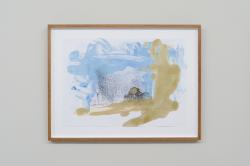
The staircase to the upper floor functions as a threshold, marking the passage from inward retreat to a sense of freedom. In The Spirit of Hope, feathers attached to the ends of moving metal rods trace through space the path of a flock rising and receding into the distance. The flight of this mechanical flock becomes a form of freedom: not as a sudden escape, but as a gradual release from whatever keeps the body and memory close to the ground. The repetitive movement does not merely represent flight; it makes it an experience of anticipation and seems to expand the space, opening a passage towards a different version of life. In the paintings accompanying the installation, dreamlike landscapes extend this sense of opening and lead the gaze towards a shared horizon, where the future does not appear as a predetermined conclusion but remains open to invention.
Freedom encounters hope where boundaries cease to appear immovable and become open to renegotiation. The former opens up the realm of possibility, while the latter keeps it habitable, giving it duration and direction. Hope is neither a consoling certainty nor a denial of the negative, but an existential persistence that keeps the future open even when the paths towards it are not yet visible. Through this conjunction, Kalli’s personal exploration acquires a collective resonance: the works become sites in which a shared experience can be recognised, keeping open the possibility of a reality that has not yet exhausted its forms. What constitutes us may then be inscribed anew, and the bonds that constrain us may be transformed without continuing to prescribe our course. At the end of the journey, flight does not signify the abandonment of what has come before. It allows the past to acquire another continuation and memory to become the point of departure for a new direction. It is precisely there, in this open movement, that the past encounters its future.
Niki Papaspyrou
Art Historian – Exhibition Curator
About the artist
Andreas Kalli (b. 1987, Larnaca, Cyprus). He studied at the Athens School of Fine Arts (2007–2012). In between, he studied at the Central Saint Martin School of Art and Design (2010–2011). During his studies atthe Athens School of Fine Arts, he attended special courses at the Printmaking Workshop (2009-2010), Graphic Arts Workshop (2009-2010), as well as Sculpture Workshop (2007-2009).
Selected solo and group exhibitions: 'Whispers of the Lake', Municipal Art Gallery of Ioannina; 'Summer Constellations', Art Seen Gallery, Nicosia; 'Servare Intaminatum', National Observatory of Athens (2026).‘ Theorems 4/2025. Botanologies: Ecology Issues in Contemporary Visual Arts Practices’, Municipal Gallery of Athens; ‘ DECENNIAL: A Creative Legacy’, Art Seen Gallery, Nicosia; ‘The Message of the Chrysalids’,Kolossi Castle, Limassol (2025). ‘Reflections’, A.G. Leventis Gallery, Nicosia; ‘Body Heat’, Droog Gallery, Amsterdam; ‘ Casts of an Island’, PSI Foundation, Limassol; ‘Land(e)scapes II’, Art Seen Gallery, Nicosia; audiovisual exhibition/installation Unfulfilled Journey, House of Cyprus, Athens (2024). ‘Post tenebras lux’, The O Gallery, Larnaca; ‘Home Hope’, parallel exhibition of the Larnaca Biennale; ‘The Lot’, Alpha C.K. Gallery, Nicosia; ‘BESTIARY’, Crux Gallery, Athens (2023). ‘Pedion, meeting place’, Pedion tou Areos, Athens; sculptural installation Happy Few at the archaeological site of Amathus, Limassol (2022). ‘The Instinct of a Secret’, The O Gallery, Larnaca (2021). ‘Young Cypriot Artists’, A.G. Leventis Gallery, Nicosia (2015). He represented Cyprus in the Young Artists Biennale No Food’s Land, Milan (2015). He has participated in many group exhibitions in Greece, France, Italy and the UK.
Parallel events to be announced soon.
For more information, please contact: Maria Stathi, Founder & Director, Art Seen
+357 22006624 | info@art-seen.org | www.art-seen.org